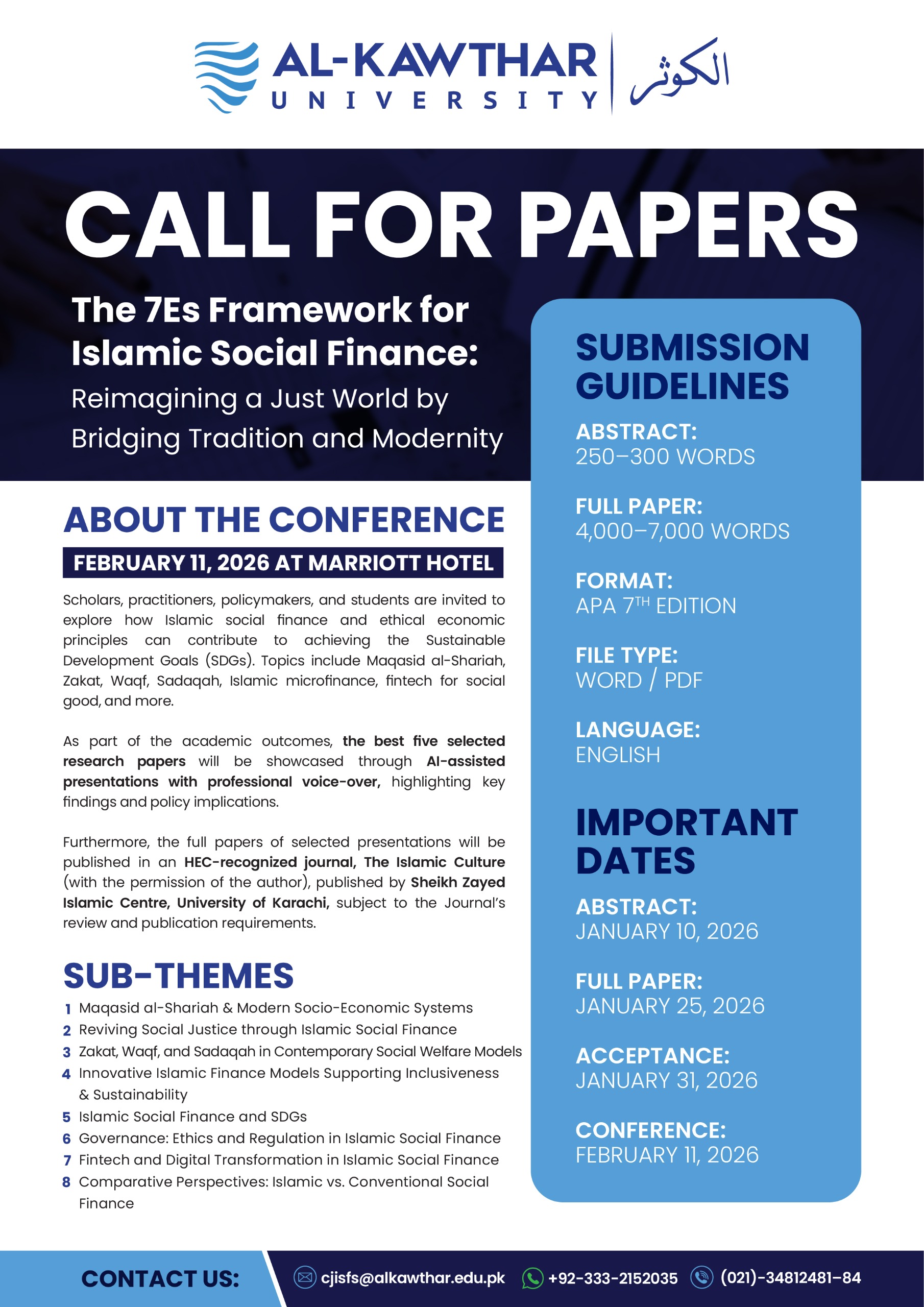
Islamic Social Finance offers a value-driven framework for addressing contemporary socio-economic challenges such as poverty, inequality, environmental degradation, and ethical governance. Rooted in Maqasid al-Shariah, Islamic socio-financial instruments—including Zakat, Waqf, Sadaqah, and inclusive finance models—provide practical mechanisms for sustainable and just development.
This International Conference is conceived as a flagship academic and institutional initiative of Al-Kawthar University, serving both as a scholarly forum and as the formal academic launch of the University. The conference introduces the 7Es Framework for Islamic Social Finance, emphasizing Economy, Ecology, Equity, Educational Excellence, and Ethical Eminence as interconnected pillars for sustainable development aligned with the United Nations Sustainable Development Goals (SDGs).
2. Rationale of the Conference
- To position Al-Kawthar University as an emerging center for Islamic socio-financial thought
- To bridge classical Islamic jurisprudence with modern socio-economic realities
- To promote Islamic Social Finance as a viable tool for SDGs
- To launch the Center of Excellence for Commercial Jurisprudence & Islamic Socio-Financial Studies
3. Objectives of the Conference
- To generate scholarly discourse on Islamic Social Finance and SDGs
- To introduce the 7Es Framework as a conceptual and policy tool
- To connect academia, practitioners, regulators, and development institutions
- To highlight practical, field-based Islamic social finance models
4. Conference Themes (Aligned with 7Es)
- Islamic Social Finance and Sustainable Economic Development (Economy)
- Environmental Responsibility and Islamic Finance (Ecology)
- Social Justice, Poverty Alleviation, and Financial Inclusion (Equity)
- Capacity Building, Research, and Knowledge Development (Educational Excellence)
- Governance, Ethics, and Regulatory Frameworks (Ethical Eminence)
- Zakat, Waqf, and Sadaqah in Contemporary Welfare Models
- FinTech and Digital Transformation in Islamic Social Finance
- Comparative Perspectives: Islamic vs. Conventional Social Finance
5. Target Participants
- National and international scholars
- Practitioners and NGOs (Zakat & Waqf institutions)
- Policymakers and regulators
- Development professionals
- Faculty members and students
6. Expected Outcomes
- Policy-oriented recommendations
- Academic publications (selected papers)
- Institutional visibility for ALKU
- Launch of Center of Excellence
- Strengthened national and international linkages
Conference Organizing Structure
Patron (VC)
↓
Conference Chairs
↓
Organizing Committee
├── Academic & Review Committee
├── Finance & Logistics Committee
├── Media & Outreach Committee
├── Protocol & Hospitality Committee
└── Monitoring & QEC Committee